
School Leaders Explain How On-Site Pools Reduce Travel Time, Simplify Logistics, And Help More Pupils Take Part In Regular Lessons.
For many PE Leads and senior leaders, the idea of changing how swimming is delivered in school isn’t held back by ambition.
Concerns about how it will work in practice usually hold it back.
Questions often come up straight away:
• Who will supervise?
• Will this disrupt the school day?
• How will it affect the timetable?
• Will it increase staff workload or safeguarding responsibilities?
These are all sensible questions to ask.
But schools that have introduced on-site swimming often say the same thing afterwards: It was much easier than they expected.
Off-Site Swimming Is Familiar But It Can Be Demanding
Most schools deliver swimming by travelling to a local pool. It’s a system that’s been in place for years, so it often feels like the safest option. However, it can bring a lot of hidden challenges.
Schools regularly have to manage:
• Transport arrangements and travel risk assessments
• Staffing ratios during travel
• Lost curriculum time
• Weekly timetable disruption
• Ongoing admin and planning
In many cases, a single swimming session can take most of a morning, even though pupils may spend less than an hour in the water.
Because it’s the traditional model, schools often accept the disruption as part of the process. But it doesn’t necessarily mean it’s the most efficient way to deliver swimming.
What Changes When Swimming Happens On Site
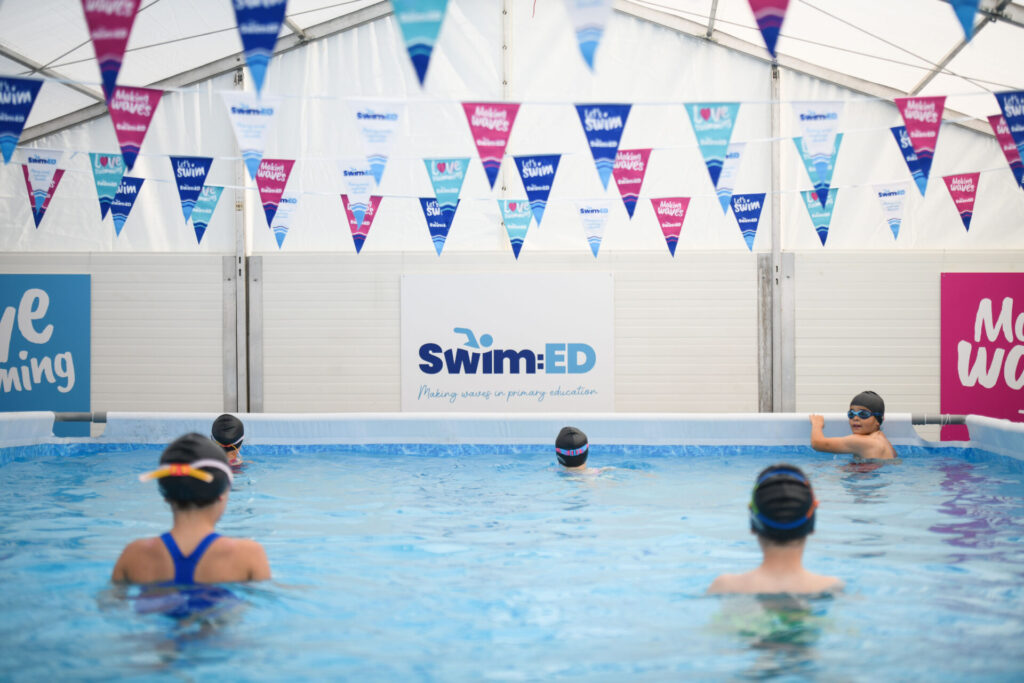
When schools bring swimming onto the playground, leaders often find the whole process becomes much simpler. Instead of managing weekly transport and scheduling challenges, the programme runs within the school day.
Schools commonly report:
• A clear installation process before lessons begin
• Short, defined delivery blocks (typically 5–7 weeks)
• Pupils walking straight to lessons
• Minimal disruption to the timetable
• No weekly transport planning
For many leaders, the difference is immediate. Swimming becomes part of the school day, rather than a logistical exercise.
Case Study: Chapmanslade C Of E Primary
“A lot easier than it may seem”
Staff at Chapmanslade Primary initially wondered whether hosting a pool on site might disrupt the school day. Instead, they experienced the opposite.
They reported:
• Smooth installation with clear communication
• Lessons running efficiently during the school day
• Pupils back in class within the hour
• Strong engagement from pupils
Their Headteacher summed up the experience simply: “Once the pool arrived, it felt as though it had always been there.” The disruption they had worried about simply never happened.
Case Study: Wodensfield Primary
Less admin, more time in the water”
Before switching to on-site swimming, Wodensfield Primary faced the familiar challenge of off-site lessons significant travel time for limited time in the pool.
With swimming delivered at school, they found:
• Pupils received 45 minutes of swimming for just one hour out of class
• Lessons focused more clearly on progress and water safety
• The timetable became easier to manage
Even when staff supported transitions to and from lessons, the process was still far more efficient than travelling to a pool each week.
Case Study: Sutton Park Primary
“Reclaiming time and improving outcomes”
At Sutton Park Primary, leaders had been spending thousands each year on transport while losing valuable curriculum time.
Bringing the pool to the school made a big difference.
They saw:
• The number of pupils swimming 25 metres increase from 0% to 52%
• 82% of pupils demonstrating strong water safety understanding
• Higher confidence and enthusiasm among pupils
As their Head of School explained:
“Bringing the pool to our playground changed everything.”
Not only did outcomes improve, the wider curriculum also benefited from the time saved.
Safeguarding & Workload: What Schools Actually Find
One of the biggest initial concerns for schools is safeguarding. Understandably, the idea of a swimming pool on site can raise questions.
However, schools delivering on-site programmes often report that safeguarding becomes simpler, not more complex.
This is largely because:
• Pupils remain within the school environment
• Supervision boundaries are clear
• Movement between locations is reduced
• The programme runs in defined, structured blocks
Staff also find that workload becomes easier to manage once the programme is underway.
That’s because:
• There’s no weekly travel planning
• Staffing needs are predictable
• Lesson structures remain consistent
• Planning materials can be reused each year
In short, the perceived risk is often greater than the reality.
What This Means For PE Leads & School Leaders
The experience of schools running on-site swimming points to an important takeaway:
High-quality swimming provision doesn’t have to be logistically complicated.
When swimming happens where pupils already are, schools often regain:
• Time
• Simpler planning
• Greater control over delivery
• Stronger outcomes for pupils
Want To Explore How It Could Work For Your School?
If you’re reviewing your future swimming provision, there are a couple of ways to see how on-site delivery works in practice.
You can:
Join a Discovery Webinar (22 April) to review safeguarding, staffing, timetabling, and delivery detail.
Download the Swim:ED Impact Report for full case studies and operational insight
Both options are designed to help school leaders make well-informed decisions, with no obligation.